
In early January 2026, Tropical Cyclone Koji threatened to make landfall on Queensland’s northern coast. Home to tropical fruit production including bananas, mangoes and melons, this part of Australia is no stranger to extreme weather events.
Meanwhile, at the same time, albeit a few thousand kilometres south, bushfires raged across regional Victoria. The fire and smoke impacting local communities in the Upper Murray and surrounds, one of Australia premier food bowls.
Although not unfamiliar to producers in each region, these events are becoming commonplace as the planet’s climate changes.
“We are seeing an increasing frequency of droughts, floods, and frost events, which can severely impact crop yields,” says Dr Victor Chu, the research leader of A-Theme at the University of Technology Sydney’s Data Science Institute. “Consequently, that is impacting the food supply chains and ultimately what we can have on our dinner plate.”
Dr Chu is leading Adaptive AI for Climate Resilience, a Food Agility CRC project in collaboration with UTS and Yamaha Agriculture.
Focusing on winegrape, apple and kiwifruit yield forecasts, the team has developed artificial intelligence (AI) models to help prepare growers for extreme weather events and long-term climate change.
Postdoctoral researcher of A-Theme, Dr Bryan Zheng, says the use of historical data in machine learning means that current AI models are not suitable for factoring in long-term changes in climate and extreme weather events. Fortunately, the team were able to find a workaround.
“We analysed trends across recent farming datasets to build in future climate change scenarios with known sectoral vulnerabilities to develop new, future-proofed frameworks for AI models on harvest outcomes,” says Dr Zheng.
“This will aid the development of targeted interventions to mitigate the adverse effects of extreme weather events on food security.”
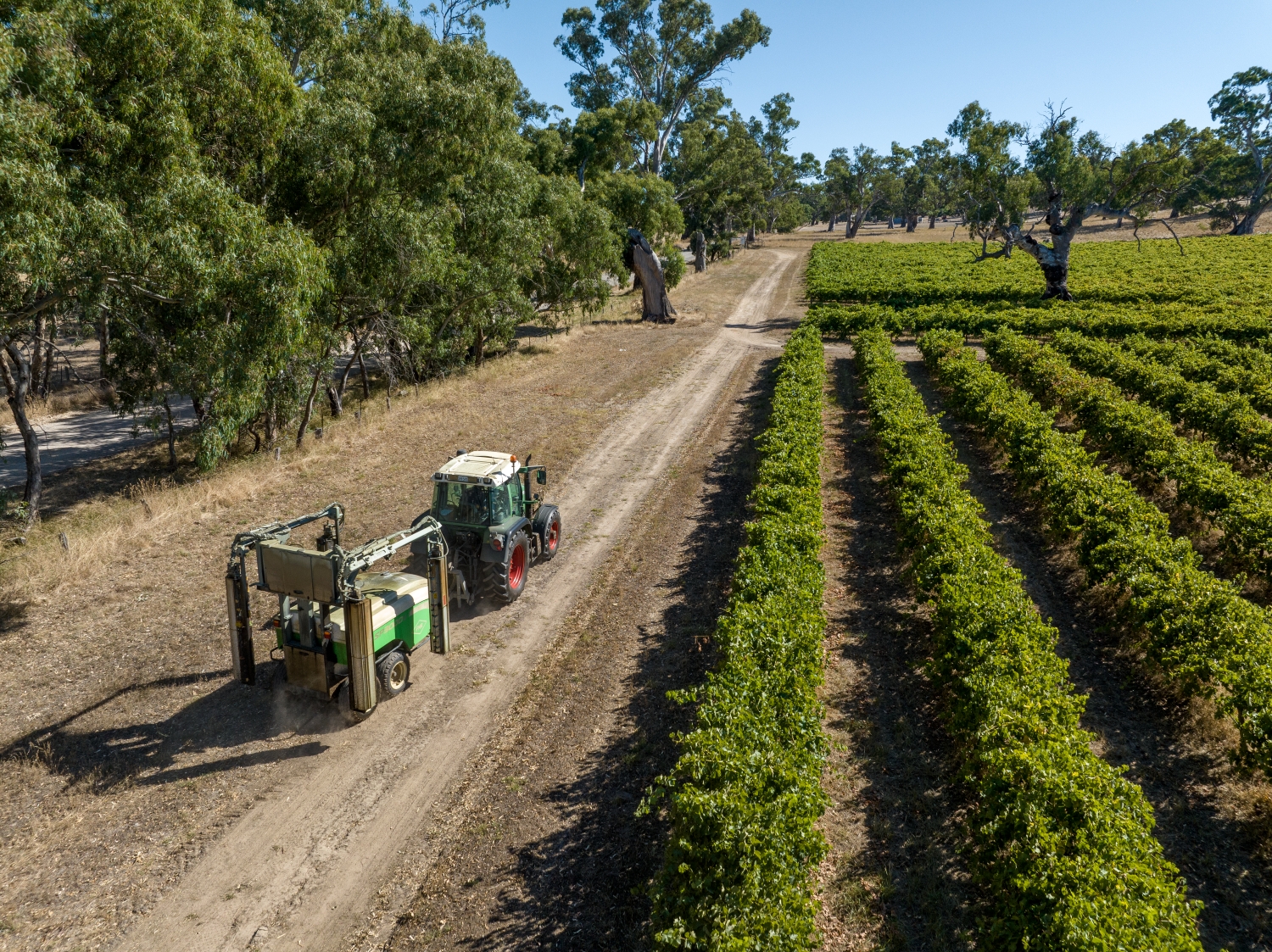
An example of this is drought, which remains one of the most persistent and costly climate risks facing Australian farmers.
“The impacts of drought often develop gradually, and they only become apparent after significant losses are already locked in,” explains Dr Zheng.
In Australia’s wine-growing regions, such as South Australia, early warning systems that combine climate forecasts, sensor signals, satellite observations, and vine growth information can identify the signals of drought risk weeks in advance.
“These systems detect early signals such as declining soil moisture, increasing evaporative demand, and prolonged heat during sensitive periods of the vintage cycle, and translate them into practical actions on the ground,” says Dr Zheng.
“Responses may include adjusting irrigation scheduling, prioritising water allocation across vineyard blocks, refining canopy and yield management plans, and making timely decisions around water insurance or other risk-transfer options,” he notes.
Additionally, Dr Chu says linking climate conditions directly to vine development and vintage outcomes enable growers to intervene earlier, “thus reducing potential losses before climate pressures translate into irreversible impacts on yield and quality,” he explains.

To the average consumer AI is a tool used to generate art, summarise emails, or take notes during meetings. It’s in the agriculture sector that the technology has a much more important role to play, says Dr Chu.
“The use of AI has quickly become essential to the farming industry around the world. However, AI models are often perceived as ‘black boxes’ that create a barrier for us to comprehend and trust. Instead, they should be something understandable and shareable allowing wider benefits to those that they benefit,” says Dr Chu.
“We need to build consumer trust and grower confidence in the technology, and we can do that by improving the way in which we explain outputs from AI models - known as explainable AI (xAI) - which we continue to work on,” he adds.
Learn more about the impact delivered by the project team in the journal; Early Warning Systems for Agriculture with Featural-Temporal Explanations.

